UAS categories have gotten complicated with all the classification systems, regulatory updates, and industry-specific designations flying around. As someone who’s worked with everything from tiny racing quads to large commercial survey drones, I learned everything there is to know about how we categorize these systems and why it actually matters. Today, I will share it all with you.
Look, when I first got into drones, the whole “categories” thing seemed like unnecessary bureaucracy. Why does it matter if my drone is “Category 1” versus “Category 2”? Turns out, it matters a lot – especially if you want to fly over people or understand what operations you can legally conduct. That’s what makes UAS categories endearing to us commercial pilots – they give us a framework for expanding our operations safely and legally.
Probably should have led with this section, honestly, but let me break down the main category systems you need to understand:
**The Part 107 Category System (Operations Over People)**
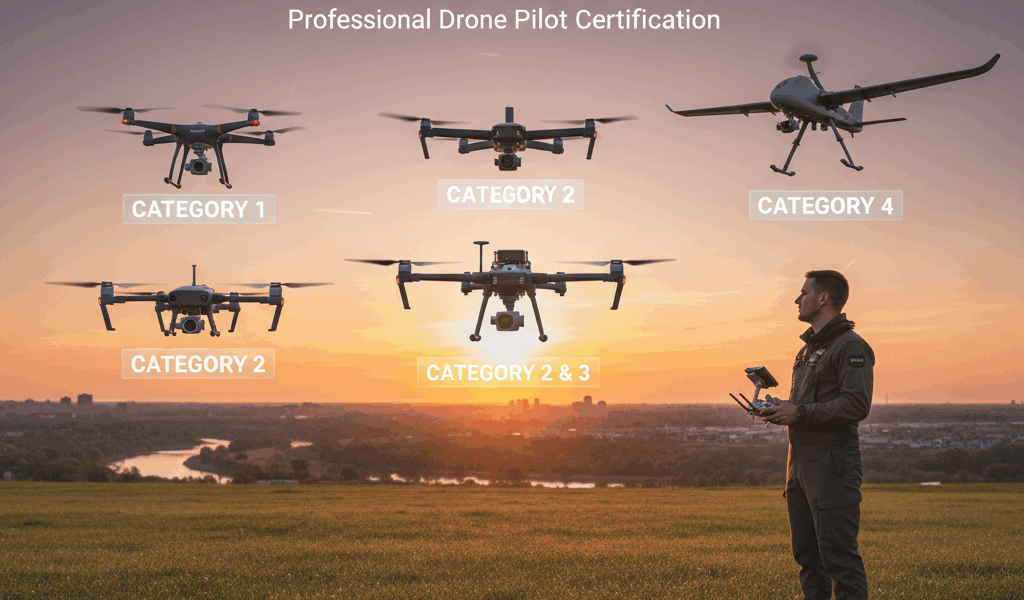
This is the big one that affects most commercial operators. The FAA created four categories specifically for operations over people and moving vehicles:
**Category 1:** These are small drones weighing 0.55 pounds (250 grams) or less, including everything attached to it. They can’t have any exposed rotating parts that could lacerate skin. If your drone meets these specs, you can fly over people without additional restrictions, though you still can’t fly over open-air assemblies (like concerts or sporting events).
**Category 2:** Drones that weigh more than 0.55 pounds but won’t cause injury to a human equivalent to or greater than the severity of an impact from 11 foot-pounds of kinetic energy. These must have an FAA-accepted Declaration of Compliance. You can fly over people, but not over open-air assemblies, and people underneath must be on notice that a drone might fly over them.
**Category 3:** Similar to Category 2 but with a 25 foot-pound kinetic energy threshold. These also need a Declaration of Compliance. The big restriction here is that you can only fly over people who are inside a closed or restricted-access site, and those people must be on notice. No sustained flight over people outside the operation.
**Category 4:** This covers drones that have an airworthiness certificate issued under Part 21. These are typically much larger systems. They can fly over people if they meet specific operating requirements, including having a maintenance program and meeting remote identification requirements.
**Classification by Size and Weight (General Use)**
Beyond the regulatory categories, the industry generally classifies UAS by size and weight. This helps in understanding capabilities and selecting the right tool for the job:
**Nano:** Under 250 grams. Think DJI Mini series, perfect for travel and casual content creation. These often get regulatory breaks because of their low weight.
**Micro:** 250 grams to 2 kg. This is your typical consumer to prosumer drone range. Most hobbyist and entry-level commercial drones fall here.
**Small:** 2 kg to 25 kg. Professional commercial drones, serious survey equipment, and specialized industrial drones.
**Medium:** 25 kg to 150 kg. Heavy-lift systems, advanced commercial operations, some military applications.
**Large:** Over 150 kg. Military, advanced research, and specialized commercial operations requiring significant payload capacity.
**Operational Domain Categories**
We also categorize UAS by where they operate:
**Aerial:** The standard drones we think about – multirotors, fixed-wing, hybrid VTOL systems. These operate in the airspace.
**Aquatic/Maritime:** Underwater drones (ROVs) and surface drones. Different regulatory framework, but still technically UAS.
**Ground-Based:** Unmanned ground vehicles. Less common in the drone world but increasingly integrated with aerial systems for comprehensive solutions.
**Capability-Based Classifications**
The sophistication and capabilities of UAS create another useful categorization:
**Basic Consumer:** Simple controls, limited sensors, primarily GPS and camera. Great for beginners and recreational use.
**Advanced Consumer/Prosumer:** Obstacle avoidance, intelligent flight modes, better cameras, longer flight times. This is where most content creators and entry-level commercial operators work.
**Professional Commercial:** Interchangeable payloads, RTK GPS for precision, advanced sensors (thermal, LiDAR, multispectral), enterprise-grade reliability.
**Industrial/Specialized:** Purpose-built for specific tasks like powerline inspection, search and rescue, or agricultural spraying. Often require specialized training and certifications.
**Why These Categories Actually Matter**
Understanding categories isn’t just academic. They determine:
– What operations you can legally conduct
– Whether you need additional waivers or authorizations
– What insurance requirements apply
– What training or certifications you need
– What clients expect when they hire you
– What equipment is appropriate for specific jobs
For example, if you want to fly over people for a construction site inspection, knowing that your drone qualifies as Category 2 means you can legally do that job. If it doesn’t, you either need a waiver or need to keep everyone clear of your flight path.
**The Evolution of Categories**
These categories aren’t static. The FAA and other regulatory bodies update them as technology advances and the industry matures. Remote ID requirements, for instance, are now affecting how categories work. Operations over people rules only came into effect in 2021, expanding what commercial operators could do.
Stay current with the latest category definitions and requirements. What applied when you got your Part 107 certification might not be the current standard. The industry is evolving rapidly, and understanding how your equipment and operations fit into these categories keeps you operating legally and competitively.


Leave a Reply