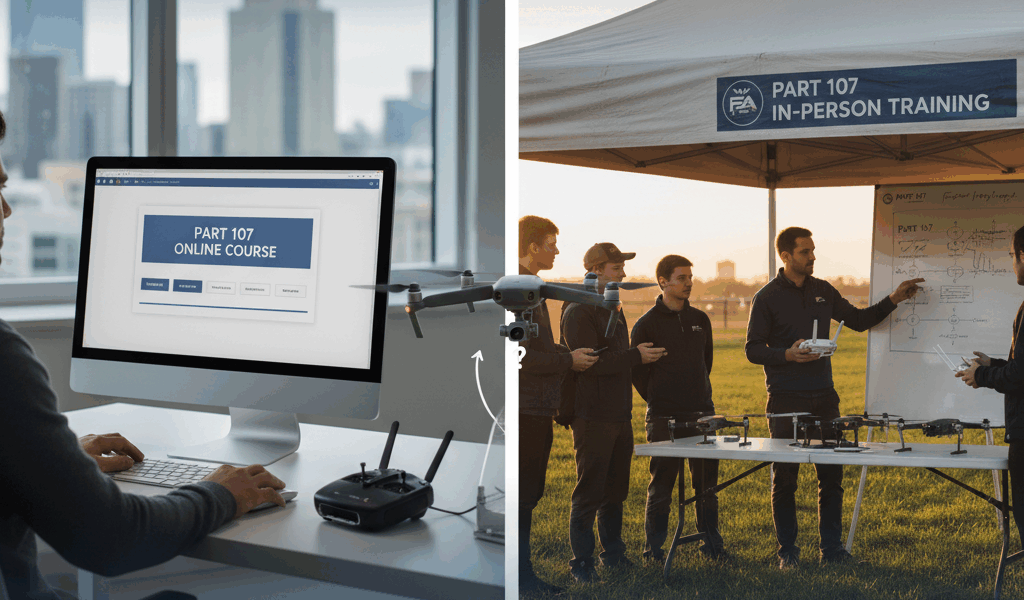
For your Part 107 exam, you’ve got two options: go to a PSI testing center in person or take the proctored exam from home. Both get you the same certification, but the experience couldn’t be more different.
Testing in Person
Walking into a PSI testing center feels like taking the SAT all over again. You check in at the desk, stash your stuff in a locker, and sit at a computer station. The proctor watches the room, and you get scratch paper plus a calculator if you need one.
What I liked about in-person testing was the zero-hassle factor. No worrying about internet dropout or webcam positioning. You sit, take the test, and walk out with your score. The whole thing—including check-in—takes about two hours.
Testing From Home
Remote proctoring caught on after the FAA approved it. You book a time slot, download the testing software, and take the exam at your own desk. A live proctor watches through your webcam the whole time.
The convenience is undeniable—no commute, no waiting room, no rescheduling because you hit traffic. But there are catches. You need a quiet, private room. Your desk has to be completely clear except for your ID. Some people find the constant webcam monitoring unsettling.
Which One Makes Sense?
If you’ve got a testing center nearby and like structured environments, go in person. Testing centers are built for focus—distractions are kept to a minimum.
If the nearest PSI location is two hours away or your schedule makes weekday appointments impossible, remote testing saves a lot of grief. Just verify your setup meets all the technical requirements before test day.
Either way, the exam is identical. Sixty questions, two-hour time limit, 70% to pass. Your preparation matters infinitely more than your location.